
Note #4
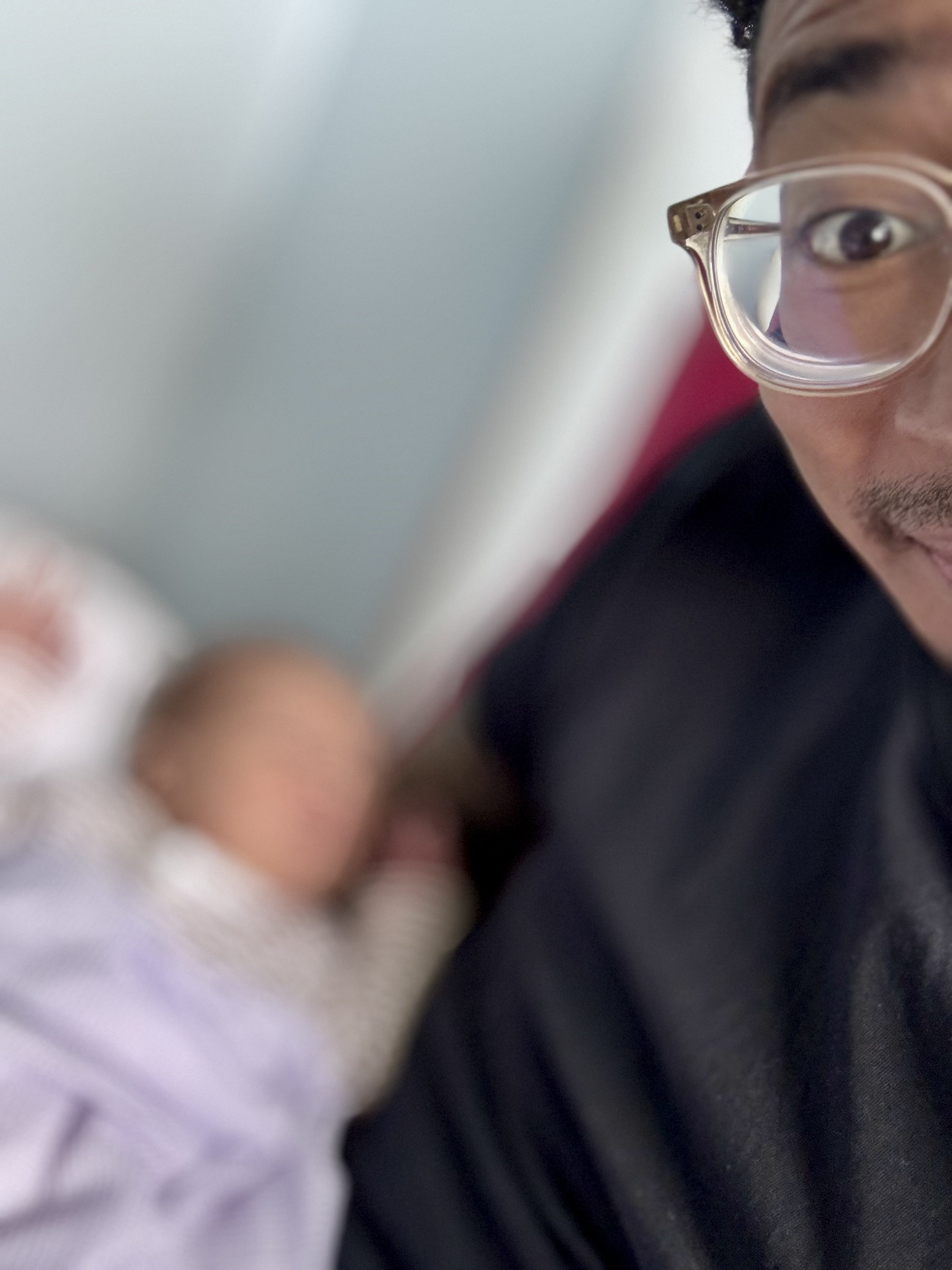
Becoming-father
This Note is a reflection on the early days of fatherhood. Enjoy!
I am now, in the official sense, a father! But I am also still becoming one. Deleuze thinks of ‘becoming’ as a process of being changed through relations. Fatherhood unfolds in the shifts of body, feeling and attention that emerge in encounter. It takes shape in real time, with and through you — my son. I am learning to feel it in the ways my body settles differently, in the altered textures of time, care and attachment.
Of course, this embodied process often begins much earlier and more intensely for mothers, from conception onwards, as pregnancy reorganises the body from the inside.
What I am trying to articulate here is my experience of how fatherhood arrives differently through sensations of proximity, repetition, touch, vigilance, and presence.
I keep returning to one of our earliest nights together. You are one day old. I take you for a while whilst your mother sleeps. Time for us to be together and bond. I am, as ever, thinking about theory and life: embodiment, materiality, affect, what it means for us to be here together like this, in this space, in this moment, in this world.
We are in the sitting room of the hospital in which you were born, a slightly more homely but still largely sanitised room, filled with the same generic toys that used to populate banks, opticians and surgeries during my own childhood.
My back aches from the reclined position I attempt to hold as you lie on my body in a stiff upright chair. I am becoming aware of my body in relation to yours, its limits, its shape, what it can and cannot offer. I wonder if my body is good enough for you.
I have become newly aware of smell. Your smell. Your mother’s smell. My smell. Research suggests that this matters for various reasons. Newborn odour appears to play a role in recognition and bonding, while maternal odour has been shown to soothe infants and shape how they orient to the world. Adults, too, seem to respond strongly to infant smell. We put your mother’s shirt next to you when you rest, wanting to keep something familiar close by. I find myself wanting to share in that world of recognition, while also knowing that her smell does something I cannot.
You flinch often, your reflexes announcing your encounter with the physicality of the world. It makes me think of Massumi’s account of movement, where even adult walking can be understood as a form of controlled falling, the body continually adjusting to force before it fully knows what it is doing.
What strikes me here is the primality of experience: the body meeting the world first through sensation, adjustment and response.
I think about theories of the dyad. I often argue that children teach us as much as we teach them. But babies? What is it that you are teaching me now? I think I am learning how to love again. Not only love as something one feels, but loving in the adjectival sense: a way of be(com)ing with you.
There is a particular quality to these early days that I (and probably others have already have) would describe as a co-restive state. We are together in the liminality of un/rest, you sleep on me and I become reluctant to move, trying not to undo the moment. I stay with the ache, the stillness, the weight of you, as if this too is part of what it means to be here together.
My body becomes disciplined into care. Rest is shared, but unevenly so. There is tenderness in that, but also a quiet asymmetry. Being needed by someone so completely sharpens the body’s awareness of itself.
Fatherhood, in these early days, feels deeply affective. Before I have words for what is happening, my body is already responding. My breathing slows to meet yours. My shoulders stiffen to keep you steady. My listening becomes vigilant. My sense of time alters.
I think about the value of writing this at all. There is literature aplenty on the experience of mothers, dads less so. There are good reasons that maternal experience has needed to be named, defended and centred. Even so, I find myself wanting to hold open some space for fatherhood as a space where something is happening that feels worth attending to. Something embodied, relational and affective. Something that does not compete with maternal experience, but sits alongside it as another way of understanding what these early days can do to a person.
Perhaps this is the simplest version of what I am trying to say: fatherhood, so far, feels like a slow reorganisation of the self through closeness, vigilance, tiredness and touch. It asks for presence in a body that aches, wonders, listens and learns.
Something is happening here, now, in me, with you.
Written for you, Baby and approved by us both - Mum and Dad.
Please also subscribe if you enjoyed this and want these to your inbox. Click on the Notes page to do this.
https://www.criticalearlyyears.org/notes