
Note #2
Welcome to Critical Early Years Notes: reflections on childhood and practice
I’ve created these Notes as a way to share my current thoughts about childhood, early years practice, and the political conditions that shape them. This is a space for me to share what I’ve been reading, noticing, and wondering about. These notes are also an invitation for you to pause, think alongside me, and sit with the questions they raise.
These Notes grow out of the privilege of being able to stay close to what’s happening across the early years sector, and a desire to share that thinking in an open, reflective way.
In Note #2 I’m thinking about othered mothers, social justice, the purpose of education, and mud.
What I’ve been reading
A short reflection on something I’ve been reading and sitting with this month.
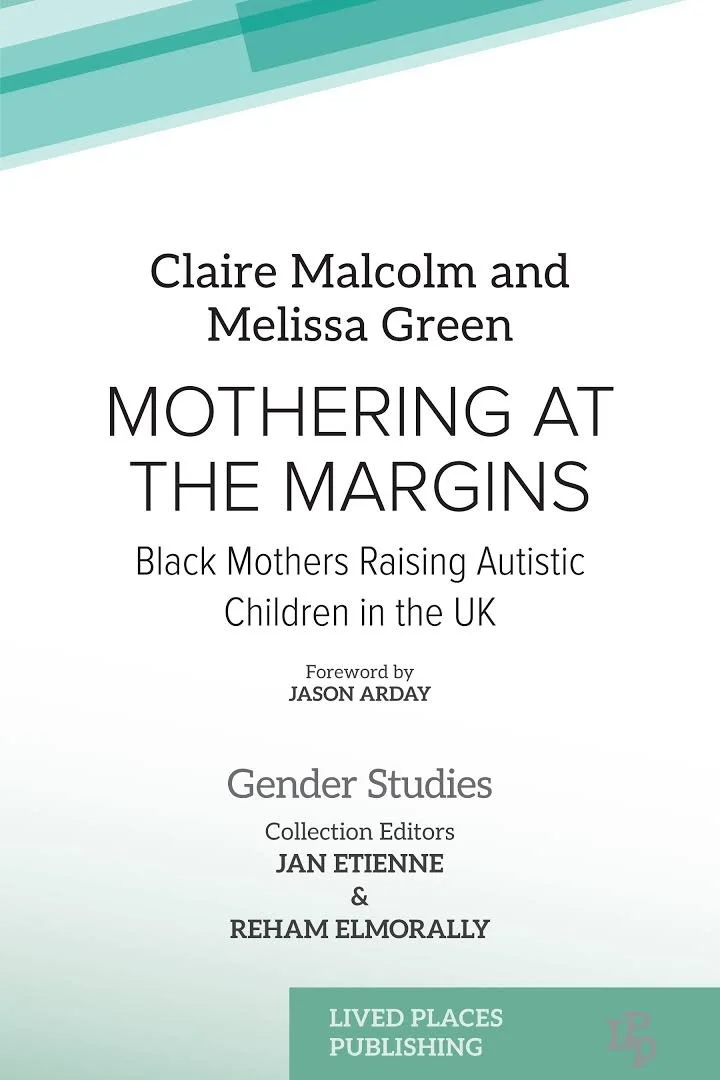
Mothering at the Margins — Claire Malcolm & Melissa Green
Mel and I both work at the Open University together and have known each other for a few years now. I first came across her work in the period following George Floyd’s murder, where she was offering some excellent training around anti-racism in the early years and how we, as a profession, can respond. In this book, alongside Claire Malcolm, she traces her own experiences as a Black ‘othered’ mother of an autistic child. This term reflects “the extent to which women like us are excluded from dominant motherhood discourses” in the face of ‘culturally incompetent’ services on which they rely.
I found it quite a powerful book that offers some really insightful experiences into how these mothers and their children are perceived by professional services. It echoes what I’ve read elsewhere about accessing special educational needs and disabilities provision for Black and mixed Black heritage children and poses several questions for us:
How might we recognise and resist dominant discourses of motherhood that marginalise some families, while positioning others as the norm?
How do race, disability, and class intersect in our understandings of children’s behaviour and development, and where might this lead to over-surveillance for some families and under-support for others?
I think you’d want to read this book if you’re interested in listening closely to mothers whose experiences of care, education, and support are shaped by race, disability, and othering — and in reflecting on what that means for early years practice.
Social Justice Thoughts
Some of you may know that I’m in the process of writing a new book on social justice in the early years.
It is intended as a CPD book for all those working with young children that blends together theory and practice to offer an accessible way of thinking about all aspects of inclusion. Social Justice is, of course, not a new topic. I think the novelty of this book will lie in my own interpretation of what that term means and will also be informed by my experiences delivering this sort of training over the past seven years.
What I’ve learned is that there is absolutely a desire to engage in this work amongst a large proportion of the profession, coupled with an ongoing sense of urgency in the current political climate. People want checklists, though, and cookie-cutter answers that don’t always respond to the complexities of the situation. This is where I’m trying to strike a balance between offering practical ways into the work, and resisting the temptation to reduce social justice to techniques or templates.
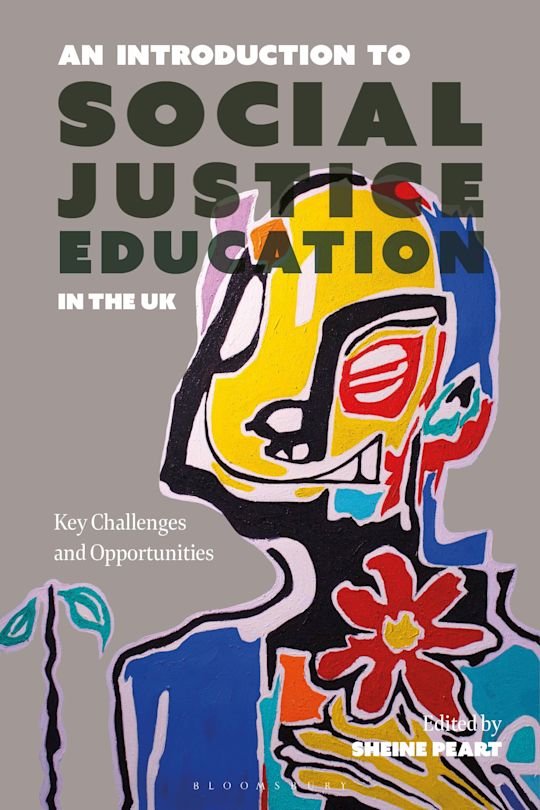
Part of the work of writing a book like this involves spending time with what has already been written. Recently, I’ve been reading An Introduction to Social Justice in Education, which includes a interesting chapter on normativity in the early years, particularly in relation to developmental assessment. The chapter raises important questions about the Early Learning Goals used at the end of the Early Years Foundation Stage, suggesting that they rest on a simplified and linear view of children’s development. In doing so, they can obscure the uneven, relational, and context-dependent ways in which children actually grow and learn.
What I found especially useful was the attention given to the position practitioners find themselves in. Many hold rich, nuanced understandings of children, shaped by close relationships and everyday practice, yet are asked to translate these understandings into fixed benchmarks that carry significant weight. These expectations are reinforced through inspection regimes and accountability structures, becoming part of the background conditions of practice.
I suppose, however, this raises the question of what the alternative would be. Radically, there are strong grounds to remove assessment altogether, but in practice, my pragmatic view is that there remains a need for shared understandings that help us notice when children are flourishing and when they may benefit from additional support.
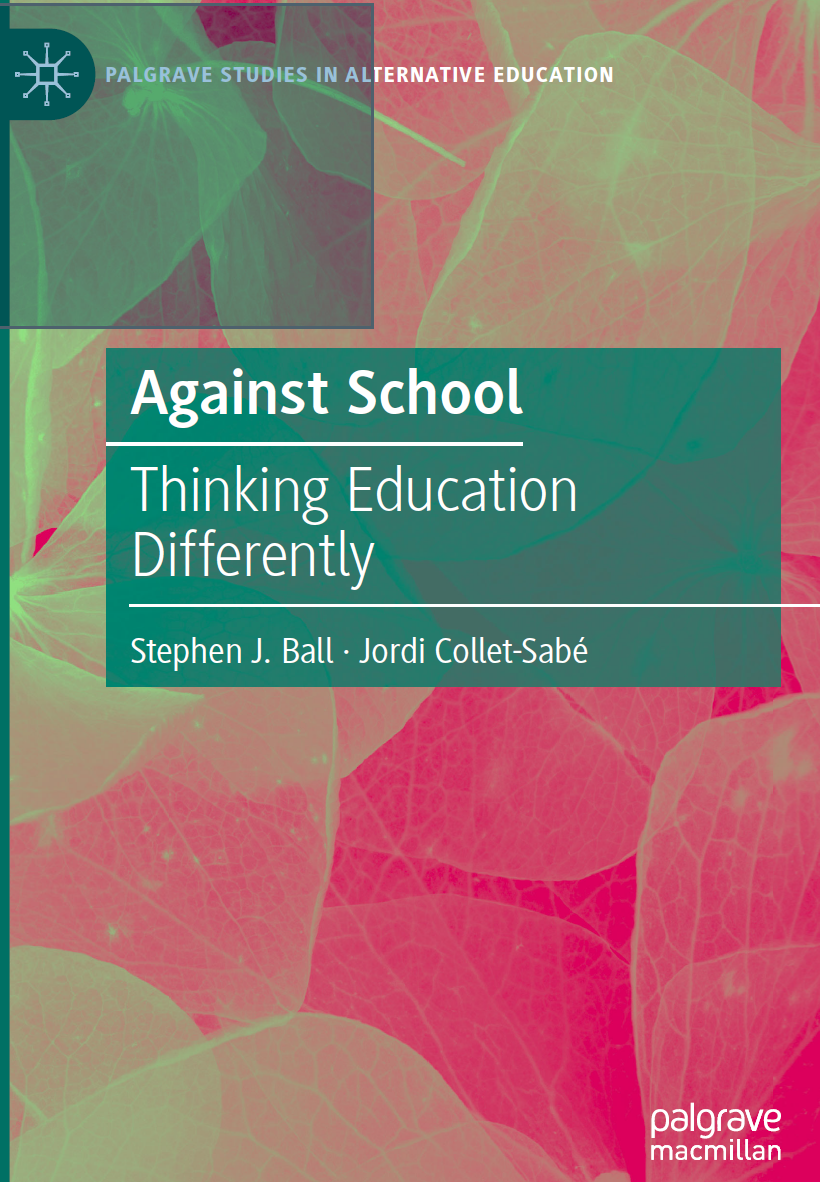
This sort of takes us back to what we believe the purpose of formal education is. I have been reading Ball and Collet-Sabé’s new text in which they argue “schools and schooling are deeply implicated within the modern project of progress, growth, individualisation, government, and consumption that has brought the planet to the edge of extinction”. This book is written in the lineage of radical texts on this matter, one of my favourites being Illich’s Deschooling Society where he challenges the assumption that institutionalised education is either neutral or inherently emancipatory. Illich’s concern was with the ways education becomes entangled with broader projects of productivity, control, and social reproduction.
This is where I keep finding myself, both in this writing and in the book more broadly — sitting with questions rather than answers. For me, the purpose of early childhood education lies less in preparing children for predetermined futures, and more in creating the conditions for them to explore, express, and imagine otherwise in the present.
Children arrive with immense creativity and radical forms of expression, most often lived out through play, movement, and relationship. Attending to this is not about abandoning attentiveness to development or support, but about resisting educational logics that narrow what is valued or visible.
These tensions, between care and accountability, attentiveness and assessment, aspiration and constraint, are not easily resolved, and perhaps shouldn’t be. They are part of the ongoing complexity of engaging seriously with social justice in the early years, and they are questions I’m continuing to sit with as the book takes shape.
Mud
A colleague shared a really interesting article with me recently, From risky play to dirty play: why young children need ‘dirty’ nature play in their lives. It is open access and broadly speaks to value of letting children get dirty!
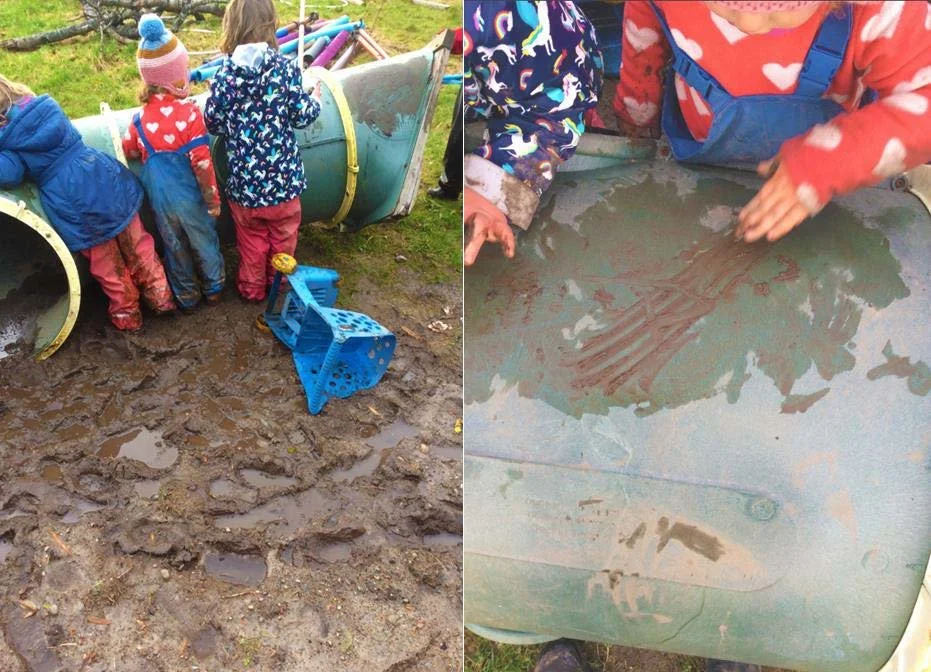
I wrote a little bit about this in my PhD. This is an (admittedly a bit dense!) extract from my fieldwork on the environment in which the children were developing their sense of selves:
“The fact, too, that the environment during my time there was ordinarily muddy meant that I did not witness any child show an aversion to being dirty for any extended period of time, regardless of their gender. The children were also free to move and redistribute the mud, or the mud was free to move and distribute the children, wherever they liked. There were no coded discursive orders for the children to ‘keep it in a certain area’, as is often the case with more conventional ‘mud kitchens’. Aesthetically, none of the materials at Wood Fire were painted in what was described to me as ‘rainbow throw-up’ colours
Wood Fire still followed health and safety requirements, especially because of the ongoing coronavirus. Children were always required to wash their hands for meals. If they became muddy or wet to a point that it was uncomfortable for them then they would be encouraged (first, and then asked) to change their clothes (the younger children were given additional support here). The material resources were also cleaned on a rota basis. My point is that the materiality of the environment elided the conformative (white) hygienic sublime (Glabau, 2019)
Overall, it felt clear that Wood Fire’s refusal to demarcate ‘what goes where’ with the mud and not subscribe to often the tyrannous standards of ‘tidying up’ created a smooth space for the children to express their subjectivities-otherwise (Deleuze and Guattari, 1987). The intra-action of-mud-child-waterproofs through assemblages challenged determinate cultural and moral (and therefore thoroughly political) knowledges about cleanliness and messiness.”
So, a reflection question to leave you with:
What assumptions about cleanliness, order, and “appropriate” behaviour are built into your environment, and how might these shape the kinds of selves children are able to express, explore, or hold back?
Thank you for reading, and for spending time with these Notes.
Dr Shaddai Tembo