
Putting Birth to 5 Matters to Work
Reflections on equity, social justice and the limits of professional guidance
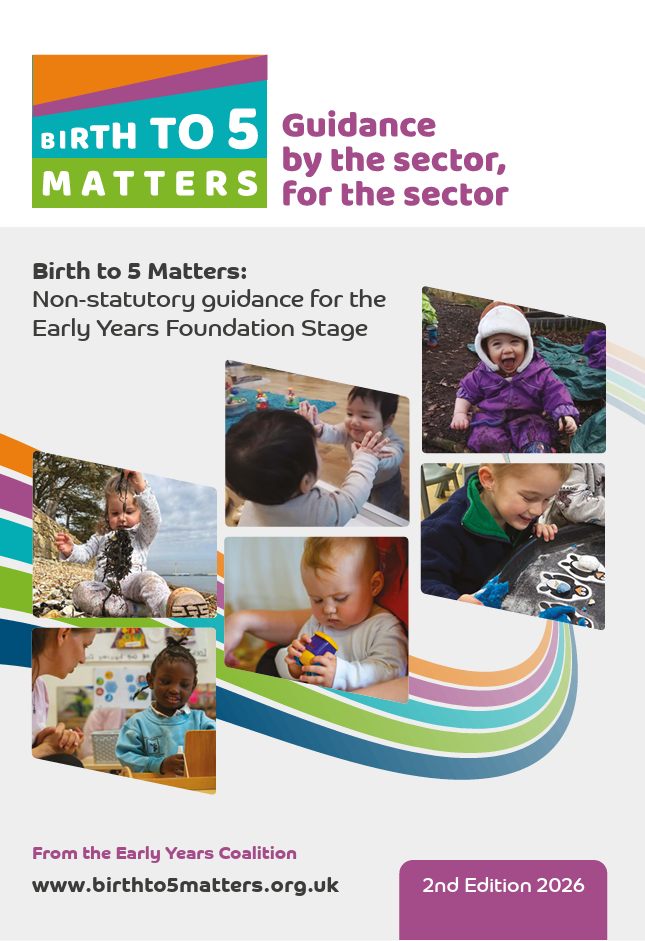
The revised Birth to 5 Matters guidance is now available. I was delighted to return to the Equality, Equity, Diversity and Inclusion Working Group, this time leading the revision of the section. It was a privilege to work alongside Sharon Colilles, Donna Gaywood, Holli Williams, Lyndsey Stanton and Liz Pemberton throughout the process, with Liz also stepping up during the final stages to support the leadership of the work and help bring it over the line.
Although this article reflects my own views, it is impossible to write about the revised guidance without acknowledging the collective thinking that shaped it. Like all good guidance, it emerged through discussion, challenge, revision and compromise.
Publication marks a significant achievement. The harder question is what happens next. How does a document like Birth to 5 Matters influence practice? What can guidance realistically achieve? And just as importantly, what can't it do?
Guidance is often judged by the quality of its writing or the strength of its ideas. Its value is ultimately tested through use. Good guidance gives us a shared language, helps us notice what we might otherwise overlook, and creates opportunities for richer professional conversations. Whether it changes children's everyday experiences depends entirely on what we educators do with it.
Why alternative guidance matters
Most educators I know do not work from a single document, nor should they. They draw on Birth to 5 Matters, Development Matters, specialist pedagogies, local authority guidance, research evidence and, importantly, the knowledge they build through their own practice. Different documents bring different emphases, different questions and different ways of knowing about children and childhood. Rather than competing with one another, they can enrich professional dialogue and help practitioners think more critically about the decisions they make every day.
Of course, I am not a neutral observer here. But I think Birth to 5 Matters continues to make one of the strongest contributions to conversations about equality, equity, diversity and inclusion. One of the strengths of the revision is that we resisted the temptation to begin again. The original section was already thoughtful and ambitious. It recognised racism, bias, inclusion, disability, gender, sexuality, belonging and children's rights. Our task was not to replace those commitments but to build on them: to make some ideas clearer, extend others in light of new research and respond to the changing political and social context in which young children and their families are living.
From equality to equity and social justice
The change in title, from Inclusive Practice and Equalities to Equality, Equity, Diversity and Inclusion, signals an important development in the section. The revised guidance now gives greater attention to the difference between equality and equity. Equality establishes that every child has equal worth, rights and entitlement. Equity asks us to consider the uneven conditions in which those rights are experienced, including the barriers that some children and families encounter within settings and communities.
The revised section also makes a clearer commitment to social justice. Early years settings are part of the social world in which inequality is produced and experienced. Decisions about whose language is heard, whose family is represented, which forms of communication are recognised and which behaviours are treated as acceptable all shape children’s experiences of belonging. Social justice has become an increasingly important focus within my own work, including a forthcoming book on social justice in the early years, so I was particularly pleased to see it named clearly within the revised guidance.
I am also proud of the stronger structural emphasis within this revision. Inequality is reproduced through individual prejudice, overt discrimination, policies, routines and assumptions that appear ordinary or neutral. Expectations around food, clothing, hygiene, communication, behaviour and development may privilege particular cultural or bodily norms. The guidance encourages educators to examine how these standards have been established, whose experiences they centre and what happens to children who do not fit them.
That same analysis runs through the section’s treatment of racism, ableism and language. Whiteness can operate as an unmarked norm against which other racial and cultural identities are judged. Monolingual assumptions can position children’s home languages as obstacles rather than resources. Developmental expectations can elevate particular ways of communicating, playing or regulating as the preferred standard.
The reference to social justice also creates space to recognise the effects of wider political events and public narratives. Children and families do not enter settings untouched by debates about migration, race, and poverty. Hostile rhetoric can affect whether families feel safe, welcome and recognised. Educators should therefore understand belonging as shaped both within the setting and by the wider conditions in which children live.
Neurodiversity, disability and SEND
One of the most substantial developments in the revised guidance is the expanded work on neurodiversity, disability and SEND, led by Kerry Murphy and colleagues. The section is much stronger in its account of ableism and in its recognition of neurodivergence and disability as ordinary forms of human diversity. It also gives greater attention to the different ways children communicate, play, regulate, and learn, including through gestures, signs, symbols, and augmentative communication.
These commitments require settings to examine the conditions around children, including environments, routines, communication and adult expectations, rather than locating every difficulty within the child.
What guidance can and cannot do
Guidance can name commitments (to social justice, to equality), legitimise difficult conversations (about ableism, about whiteness) and give educators a shared language for examining practice. It can also become performative insofar as a setting may refer to equity in its policies, display diverse books and resources, or deliver a one-off training session while leaving its routines, expectations, and relationships largely unchanged. The tension is that the rhetoric of inclusion can sit comfortably alongside practices that continue to marginalise children and families.
The revised section requires educators to examine their own assumptions, recognise structural inequalities, listen carefully to families and adapt practice in response to children’s different ways of being and communicating. That work takes time, knowledge and sustained professional reflection. It also depends on skilled educators, supportive leadership and opportunities to think together. I am well aware that reflective practice without protected time can quickly become another aspiration placed on an already stretched workforce.
Guidance alone cannot dismantle racism, ableism or wider social inequalities by itself. It cannot compensate for inadequate resources or insufficient professional development. It can, however, make it harder for the sector to claim that these issues sit outside early years practice. It provides a springboard from which educators can identify exclusion, challenge established assumptions and demand the conditions needed to work more equitably.
A living document
My hope is that the revised guidance becomes something educators return to regularly, rather than a document read once and then shelved. A staff team might take one paragraph into a meeting, use it to examine a routine or discuss how a particular child is experiencing the setting. Leaders might use it when reviewing policies, planning professional development or considering whose knowledge is informing decisions. Teacher educators and researchers can use it to connect conceptual debates about inequality with the details of practice.
The guidance can also help settings hold themselves to account. Are children’s home languages genuinely welcomed? Whose families and communities are visible in the environment? Which forms of communication are recognised? Which behaviours are interpreted as acceptable, and according to whose expectations? Where are children expected to adapt to the setting when the setting could adapt to them? These questions need to be asked repeatedly because practice, communities and political conditions continue to change.
There is no final point at which a setting becomes fully equitable or inclusive. The work involves noticing, listening, revisiting and changing course. Progress may appear through small decisions: changing a routine, questioning a familiar phrase, recognising a child’s communication, or responding differently to a family’s knowledge and experience. Those decisions accumulate into the culture children encounter each day.
Birth to 5 Matters offers a strong backbone for that work. It provides principles, language and questions that educators can use in their own contexts. Its publication marks the completion of one stage of collective work and the beginning of another. The value of the revised guidance will be realised through the conversations it opens, the assumptions it unsettles and the changes educators make in response.