
Sanctuary, Belonging and the Early Years: Case Studies from Bristol
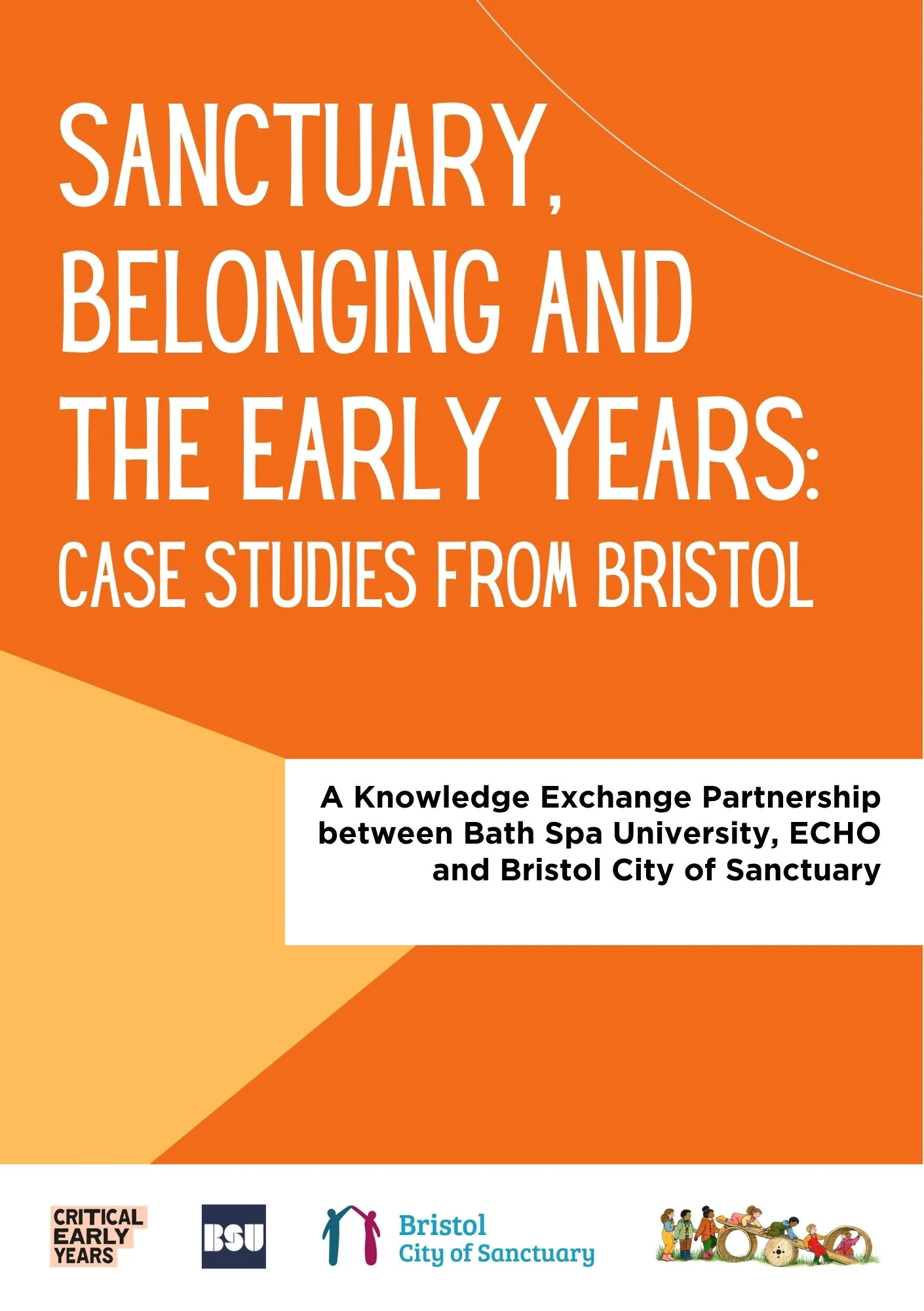
Sanctuary, Belonging and the Early Years: Case Studies from Bristol cover.
I’m pleased to share Sanctuary, Belonging and the Early Years: Case Studies from Bristol, a new practitioner booklet developed through a Knowledge Exchange partnership between Bath Spa University, ECHO / Early Education Bristol and Bristol City of Sanctuary.
The project emerged from a desire to respond to changing conditions for the early years sector in in Bristol. During the summer and autumn of 2025, tensions around migration and belonging became increasingly visible across the city. This raised urgent questions about the role and responsibility of early years settings when babies, young children and their families encounter hostility, racism, xenophobia, and about what it means to stand in solidarity with families.
What is in the booklet?
The booklet brings together seven stories from settings across Bristol. They show sanctuary through different forms of practice, including:
standing alongside families facing anti-migrant hostility;
embedding sanctuary across a whole setting;
rebuilding safety and trust with a newly arrived family;
responding to racism with children through the curriculum;
helping children act on questions of home, care and community responsibility;
creating safety beyond the school gates; and
recognising families as storytellers, contributors and co-educators.
Each case study includes questions for reflection that can be used in staff meetings, professional development and conversations with families and local partners. The final section draws the stories together and asks what collective action might be needed when racism, xenophobia, anti-migrant rhetoric and far-right activity affect children and communities.
Sanctuary as routine early years practice
One of the central ideas running through the booklet is that sanctuary belongs within the responsibilities already associated with good early years practice: safeguarding children, developing trusting relationships with families, widening participation, responding to racism, advancing social justice and creating conditions in which children and families can belong.
The stories are intentionally varied. They offer local examples of settings responding to particular circumstances rather than a single model to reproduce. They also make visible some of the uncertainty and difficult decision-making involved in this work: how to act when staff feel exposed, how to respond to hostility in the surrounding community, how institutional policies can affect access, and how children can be included thoughtfully in conversations about injustice.
Governments change, policy climates shift, and hostility towards particular communities can intensify quickly. The relationships, confidence and partnerships needed to respond can be developed before those moments arrive.
Download the booklet
The booklet is free to download, use and share with colleagues.
We hope it helps practitioners in any provision, as well as leaders, and local networks to reflect on what sanctuary, safety, recognition, participation, and belonging require in their own communities — and encourages more early years providers in Bristol to connect with Bristol City of Sanctuary.
About the project
The booklet was funded through Bath Spa University’s Knowledge Exchange activity and developed in partnership with ECHO / Early Education Bristol and Bristol City of Sanctuary. It includes a foreword from Adele Owen, Director of Bristol City of Sanctuary, and contributions from practitioners and settings across Bristol and the surrounding area.